
The Town’s Clock Tower
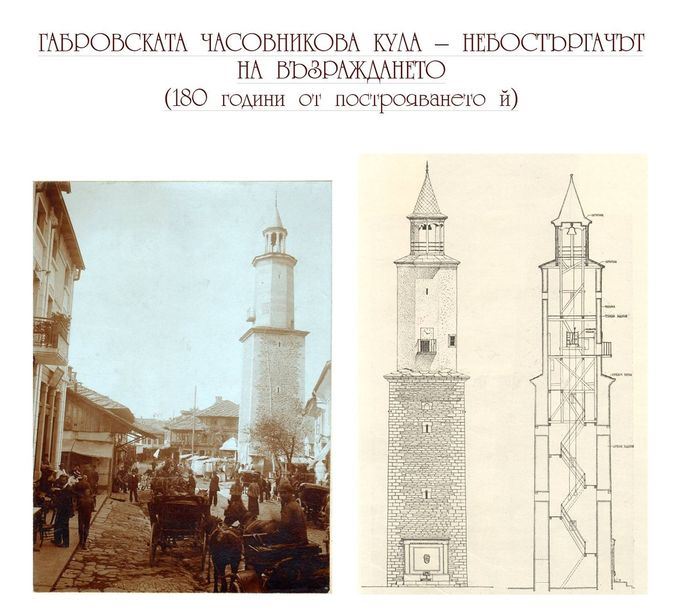
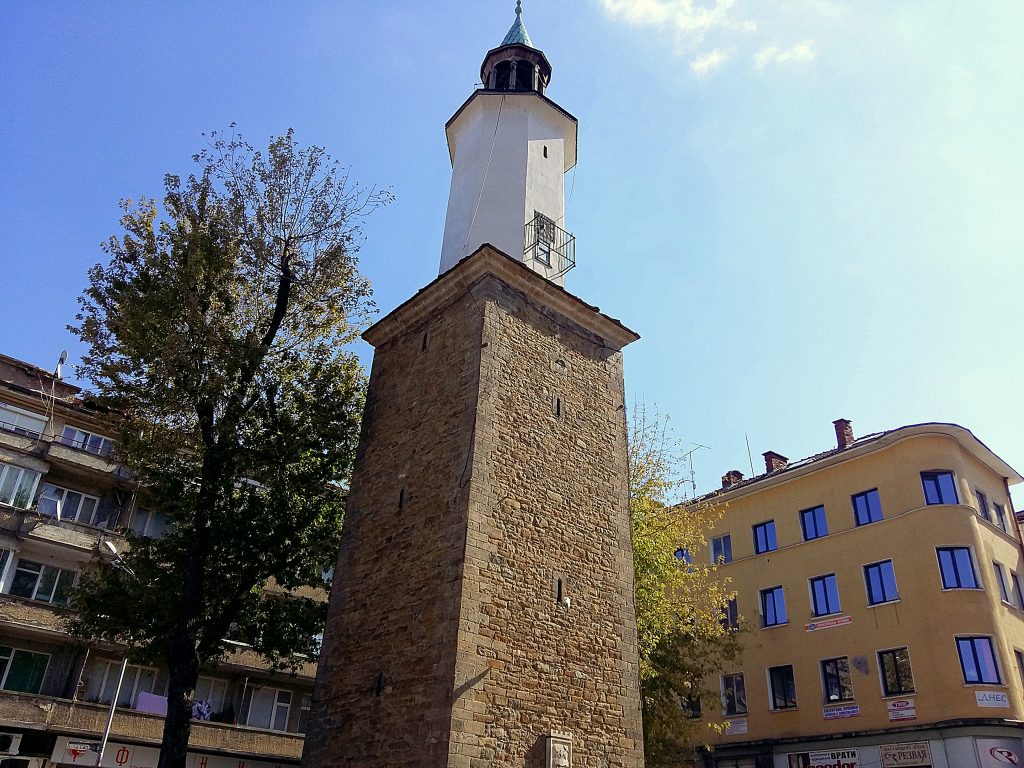
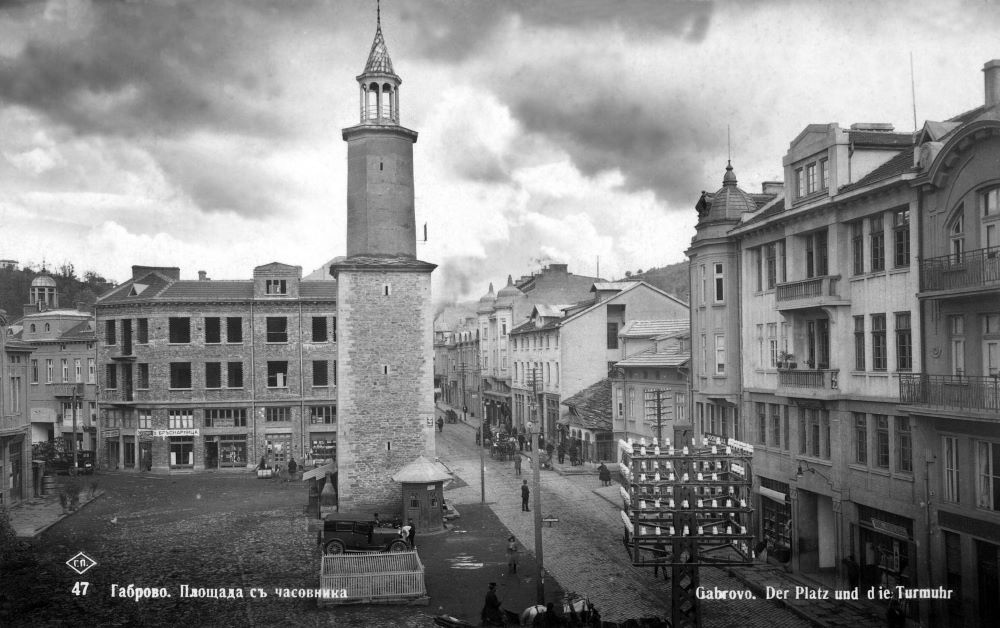
The Gabrovo Clock Tower is the highest in Bulgaria after the towers in Botevgrad and Bansko. Architecturally, it belongs to the so called Tryavna type. However, the extended proportions of its individual parts is an unusual phenomenon in the Revival construction practice. At its creation, the tower, 27.70 meters high, stood out sharply above the low-rise centre of Gabrovo. Passengers who came to the settlement heard its bell ringing from afar.
As early as the 17th century, clock towers appeared in Bulgarian settlements, and in the 18th century they were already an integral part of their central space. After the burning of Gabrovo in 1798 of the troops of Kapudan Hussein Pasha, only two buildings survived – the old stone bridge (Konashki Bridge from 1749) and the ClockTower. According to the historiographer Dr. Petar Tsonchev, the 18th-century tower was probably not particularly high. Evidence of the existence of a clock tower in Gabrovo in the 18th century is a notebook of Hadji Hristo Rachkov, who in 1799 carefully noted in it that Gabrovo was divided into five neighborhoods, one of which was called “Sahat”, i.e. the neighborhood with the clock.
In 1828, Gabrovians decided to build a new clock tower. In order to avoid unfair competition in craft workshops and commercial shops – for the simultaneous raising and lowering of their shutters under the blows of the “sakhat” (the clock), the place of the clock tower is chosen so that it can be seen and heard from the main street (today’s “Radetska”). In the same year, three wealthy men, “chorbadjii” and the tax collector Georgi agreed with the Kazanlak Turk Hafouz aga for a clockwork worth 2,150 Groschen. But the construction was postponed by several years due to the Russo-Turkish War of 1828-1829. The tower was completed in 1835 with the funds of Gabrovian philistines and the voluntary work of Gabrovian peasants. As it says on its Bulgarian inscription on the western wall – “1835 March 11 this pillar [tower] was erected upon the insistence and by the labour of Gabrovian peasants”. The first traveller to mention the city clock was the Frenchman Ami Boué in 1838, writing about the central “big, very long and poorly paved street” of Gabrovo, in the middle of which “there is something like a square with a lot of shops and a clock tower”. In 1871, the Gabrovo teacher Iliya Hristovich describes the clock tower in more detail, pointing out that “in the very centre of the city, as some guardian, the city sakhat rises high.”
The bell for the watch was delivered from Vienna, as our inscription in Latin faithfully convinces us – “Mich goss Johann Georg Fielgrader in Wien anno 1792”. In his notebook the merchant Rachko Tsankov wrote: “1835 July 1 I completed the tower of the sakhat and raised the chanat [the bell].” The watch did not have a dial until 1901-1902. It only counted the hours by ringing the bell. It was only in the first years of the twentieth century, at the direction of the Armenian watchmaker Mihail Artin Boyadzhiyan the carpenter Mincho Ivanov Kanev developed an additional mechanism for the movement of the hands of the dial, and the ironworker Matyo Ivanov – the iron parts of the new mechanism and the arrows. Gabrovo Clock Tower – this vertical dominant over the urban environment guarded the work of craftsmen and showed their growing economic strength in the future industrial Manchester of Bulgaria. Today it is among the few original witnesses to our bygone times.